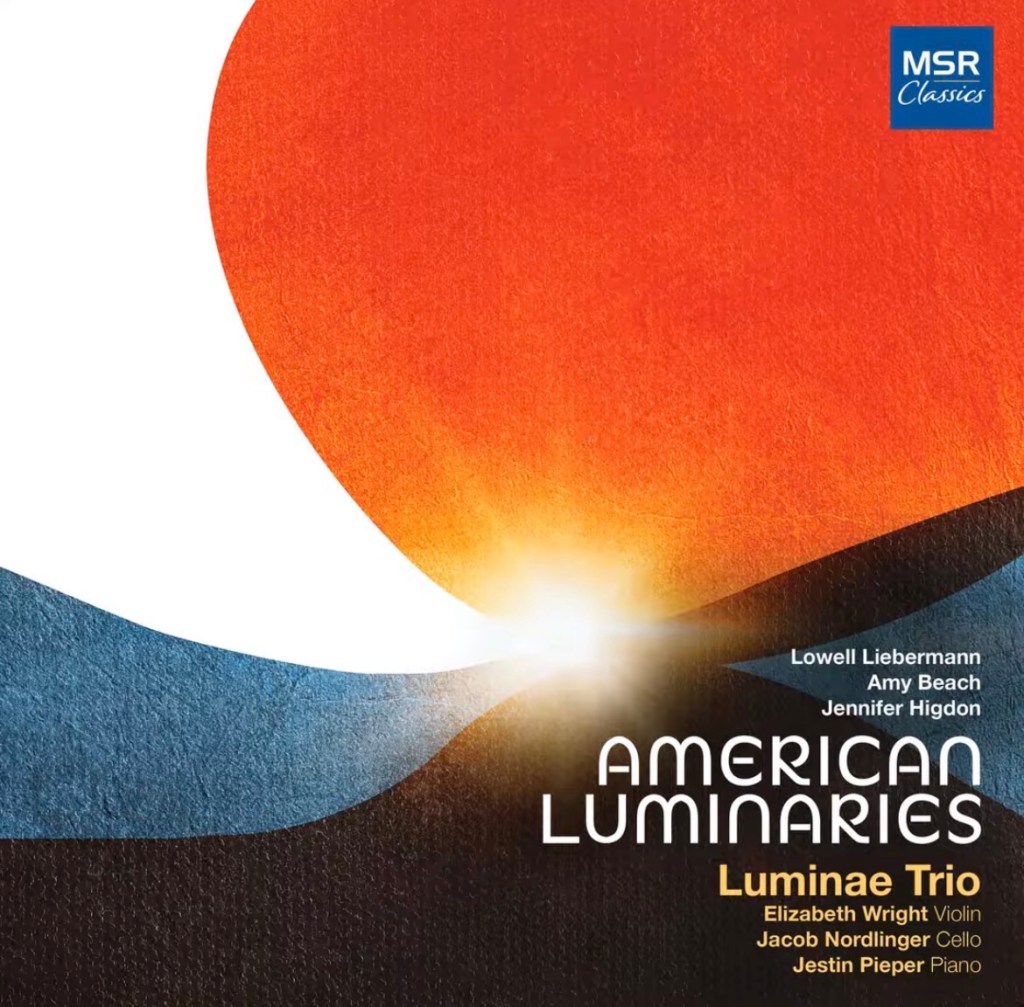
Winners of The American Prize, New York-based Luminae Trio champion a vision of chamber music that is diverse, expansive, and technically sound in their debut album American Luminaries. Taking on two contemporary works and one romantic, the trio demonstrate a likeness for innovative compositions in this album but also act carefully to not push the boundaries of accessibility too far. While they may at times dabble in the experimental and non-melodic, Luminae Trio most often choose to lean into expressive playing styles and beauty that isn’t hard to grasp.
Their first choice of composition, Piano Trio No. 1 by Lowell Liebermann, illustrates that disposition to a tee. Liebermann’s music has been labeled by some as a fusion of the modern and traditional in an accessible style. The piece does not carry forward simplistic melodies, but it does present its fair share of ear candy – at least in the way the Luminae Trio lean into expressivism with the lines that Liebermann gives them.
The second piece comes from Amy Beach, a pioneering female figure and prominent member of the New England cadre of composers of the late 19th and early 20th centuries. Almost instantly, Beach’s style and the way it is performed by the Luminae Trio brought me back to a cd of Joshua Bell performing Kreisler that I was gifted as a child while in the throes of developing my own proficiency on the violin. The cd was and has always been my favorite recording of classical music, meaning any resemblance to it conjures positive feelings for me. The violinist of the trio, Elizabeth Wright, really conjures Bell’s expressive style here with vibratos that are both thick and precise. The pianist of the group, Jestin Pieper, also reminds me of the Kreisler collection with his playful style in the Allegro, and the cellist Jacob Nordlinger embodies a similar style. The entire middle section of the album is performed with the kind of exquisite vibrato and dramatic dynamics that a romantic piece requires, and it serves as the ideal representation of an under-represented female composer of that period.
In the album’s third part, the group close things out with a delectable piece of contemporary composition by Jennifer Higdon. Designed to evoke specific colors, the piece is performed masterfully by the forward-facing trio that are really making a statement here. Higdon’s work is a golden choice for this trio’s brand of intellectual yet raw style of performance.
All in all, the Luminae Trio have chosen three ideal compositions to embody their commitment to representing the under-appreciated and their unique mix of accessibility and modernism. This is an album to dig into or tune out to, whichever may be your style. Classical chamber music may be many decades past its peak of popularity, but the Luminae Trio certainly make a case for its comeback in their debut album “American Luminaries”.
Stream the album here and sign up for their email list to stay up to date.
Follow our Up and Comers playlist for more new music discovery.


Leave a Reply