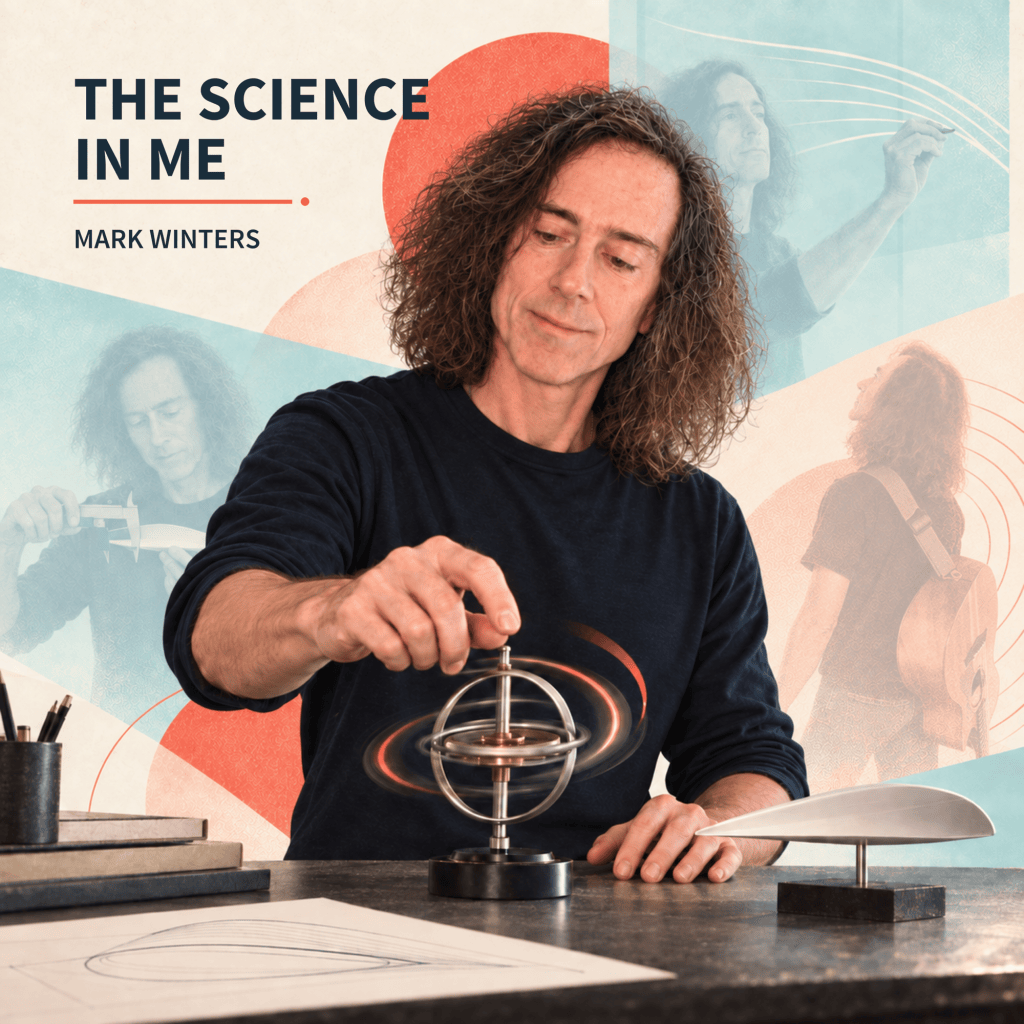
Deep reflection, gratitude, and a scientific curiosity come together in Mark Winter’s “The Science In Me” album. Though rife with scientific terminology and concepts, the album is ultimately rooted in human feeling and invites us to explore the connections between the worlds of the physical and emotional.
Winter’s musicality is perhaps most anchored in positivity and wonder. Where some might use a guitar and a melody to vent frustration, anger, or hopelessness, Winter uses the musical tools at his disposal to openly explore the world and relationships around him – even those that cause pain (not that there is anything wrong with the former approach). In the opening track, “Can I Rise”, for example, he asks whether the person he currently is is enough to achieve big things in this life. Though he has his doubts, the song is ultimately a positive one that proudly displays his heritage in a warm and positive manner. In “Let It Rain”, a song about his late brother, he uses the image of rain washing away debris as a metaphor for moving through the pain of loss. Again, while there is grief and darkness here, Winters chooses to use an uplifting metaphor to talk about moving forward. “Triangulation”, perhaps one of the most interesting and unique tracks on the album, takes a rather neutral topic (“the scientific method of locating a position from multiple points”) and presents it in a joyful light. Triangulation is displayed here as more than just a tactic of observation; it is something that brings him closer to the object of his affections.
Other songs on the album are more directly positive in nature. “Fake Gravity” sees Winters gushing about his love: “If you’re really real, maybe gravity’s fake”. In a similar vein, in “Into The Flow”, Winters uses an upbeat Jason Mraz-esque chord progression and production style to discuss going out into the light of the day to bask in the ecstasy of a flow state. In “Speed of Light”, he employs an acoustic riff very reminiscent of The National in their early days and describes the joy of observing the world passing by from the seat of his bicycle.
At other moments, Winters positions himself as a questioner of unfettered technological progress. The song “What Does It Mean To Be Human?” sees Winters call out the negative effects of artificial intelligence on the human experience. The repeated line “Take my troubles away, help me to connect, tell me what to say, electrons take me closer but I feel further away” embodies an internal dialogue many of us are having right now as we see automated technology take on skills that humans once owned. Though Winters demonstrates a heavy emphasis on scientific ideas in this album, it’s clear that his music rests in humanism. Science, in his view, is inextricably linked to human feeling and ingenuity.
Overall, if you are looking for music that goes beyond traditional love song formulas, Mark Winters’ “The Science In Me” album has plenty for you to chew on. It’s a collection of songs that explores the intersections of scientific principles and human experience in an expansive and heartfelt way. It’s also just full of earworms that remind us at times of artists like Ben Kweller (a fellow Texan, it’s worth noting), Jack Johnson, and even The National. Stream the album here and follow Winters on social media to stay up on his releases.
Follow our Up and Comers playlist to discover more emerging acts you’ve probably never heard of.


Leave a Reply